


Chicken Cage
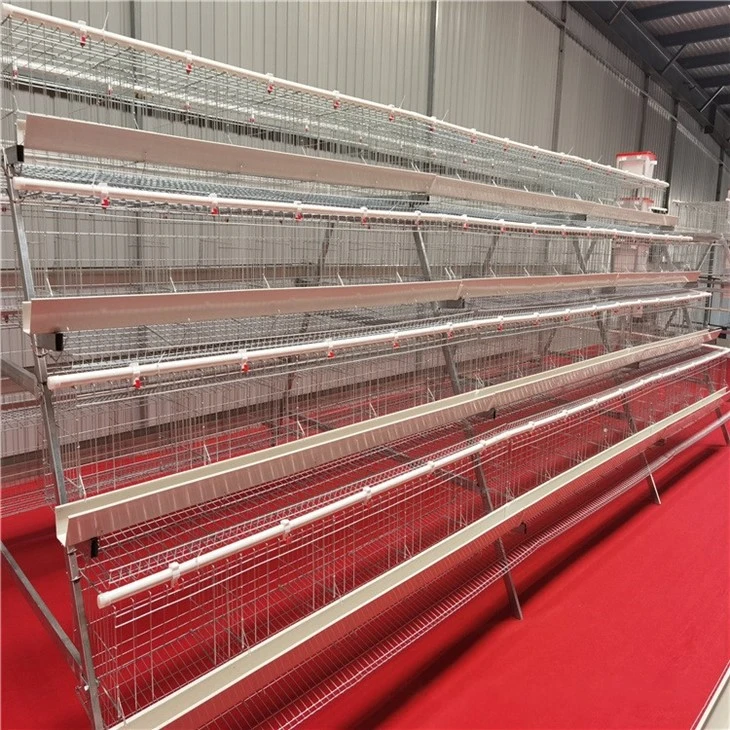
Chicken cages, also known as poultry cages or chicken coops, are structures designed to house and confine chickens in a controlled environment. These cages provide a systematic and organized way to raise chickens, particularly in commercial poultry farming operations. Chicken cages come in various designs, sizes, and materials, but they generally serve the purpose of providing shelter, safety, and optimal conditions for the birds.
Advantages of Chicken Cage
High Feeding Density
Make full use of chicken coops and various technical equipment to increase the density of chickens. Generally, only 5-6 chickens can be raised per square meter of ground, and a maximum of 20 chickens can be raised in a three-layer vertical overlapping cage. This greatly saves the space and cost required to construct the chicken coop.
Save labor
The chickens are kept in cages, unable to move, no water, no feed trough or spawning box. Eggs can be automatically rolled out of the cage, which is convenient for picking up eggs. Therefore, it can save time for fecal removal and other management.
Reduce Feed Waste
There is little waste of feed and low consumption. The feed trough is placed on the ground in the chicken house. Feed is also easy to throw away as waste. The chickens in the cage are fed outside, and the chickens stick out their heads to eat outside the fence, eliminating the waste of feed. At the same time, caged chickens limit the activities of the chickens, so the heat energy consumption is minimal, and the chickens are quiet.
Low Incidence
Facilitate epidemic prevention and reduce disease. Raising chicken cages in cages where humans and chickens are not in contact with chickens and chickens with manure can prevent or reduce the chance of disease transmission, control the occurrence and prevalence of parasitic diseases and infectious diseases, increase the survival rate of chickens, and greatly reduce medical expenses.
Easy To Manage
The chickens are kept in cages, which are easy to care for and supervise. It is also easy to find sick chickens faster and prevent chickens from pecking on the ground. The cage door of the stepped chicken coop is a push-pull design. If the flocks fight or get sick, the staff can easily catch and manage the flocks in time.
High Egg Production Rate
For chickens with low productivity, feed can be adjusted to maintain a good production level. At the same time, there is no food competition in the cage, and balanced intake of nutrients and normal development of the chickens ensure the stable and high yield of the chickens.
Easy To Control Temperature And Humidity
The temperature and humidity of the chicken house are easy to control, the ventilation is convenient, and the environmental conditions around the chicken body are standardized.
Scientific Feeding
Feeding, water supply, and egg picking are all carried out outside the cage to keep the feed, drinking water and eggs clean without disturbing the chickens. Keep a quiet environment so that the chickens can produce. Eggs in a stable and balanced manner.
Reduce Egg Breakage Rate
The eggs produced by the chickens are rolled out of the cage directly without touching the feces. Not only the rate of broken eggs is greatly reduced, but it can also be kept clean.
Safe To Use
The welding density of the bottom net and the top net of the cage can be adjusted to avoid the phenomenon of chicken hanging. The wire around the screen can be thickened to increase the pressure-bearing capacity of the cage.
-
![3 Levels 4 Door Chicken Layer Cage]() 3 Levels 4 Door Chicken Layer CageA chicken cage is a cage designed specifically for raising chickens, and its size and shape depend on the type and quantity of chickens being raised.read more
3 Levels 4 Door Chicken Layer CageA chicken cage is a cage designed specifically for raising chickens, and its size and shape depend on the type and quantity of chickens being raised.read more -
![3 Levels 5 Door Chicken Layer Cage]() 3 Levels 5 Door Chicken Layer CageThree-layer (Type A) five-horizontal sliding door laying hen cage adopts cold-drawn galvanizing system, galvanizedread more
3 Levels 5 Door Chicken Layer CageThree-layer (Type A) five-horizontal sliding door laying hen cage adopts cold-drawn galvanizing system, galvanizedread more
delicate and durable, and has anti-corrosion function, and the chicken cage... -
![4 Levels 4 Door Chicken Layer Cage]() 4 Levels 4 Door Chicken Layer CageHot-dip galvanized chicken cage is a kind of hot-dip galvanized chicken equipment, which has good corrosion resistance and long service life. Hot-dip galvanized chicken cages can provide a safe...read more
4 Levels 4 Door Chicken Layer CageHot-dip galvanized chicken cage is a kind of hot-dip galvanized chicken equipment, which has good corrosion resistance and long service life. Hot-dip galvanized chicken cages can provide a safe...read more -
![4 Levels 5 Door Chicken Layer Cage]() 4 Levels 5 Door Chicken Layer CageThe hot-dip galvanized egg chicken cage is treated with hot-dip galvanizing technology, which has the characteristics of corrosion resistance, long service life, space saving, increased breeding...read more
4 Levels 5 Door Chicken Layer CageThe hot-dip galvanized egg chicken cage is treated with hot-dip galvanizing technology, which has the characteristics of corrosion resistance, long service life, space saving, increased breeding...read more -
![3 Levels 2 Doors Chicken Broiler Cage]() 3 Levels 2 Doors Chicken Broiler CageBroiler cage is a chicken cage specially designed for broiler breeding, its main role is to provide a comfortable living environment for broilers, but also help to improve breeding efficiency....read more
3 Levels 2 Doors Chicken Broiler CageBroiler cage is a chicken cage specially designed for broiler breeding, its main role is to provide a comfortable living environment for broilers, but also help to improve breeding efficiency....read more -
![4 Levels 2 Doors Chicken Broiler Cage]() 4 Levels 2 Doors Chicken Broiler CageThe stacked type is made up of multiple layers of chicken coops overlapping each other, and there are manure cleaningread more
4 Levels 2 Doors Chicken Broiler CageThe stacked type is made up of multiple layers of chicken coops overlapping each other, and there are manure cleaningread more
belts between each layer


Why Choose Us
Experienced Team
Our team of engineers and technicians has years of experience in the industry, and we leverage that expertise to provide our clients with the best possible solutions.
Quality Assurance
We have 100% quality guarantee to customers. We will be responsible for any quality problem.
24H Online Service
We try and respond to all concerns within 24 hours and our teams are always at your disposal in case of any emergencies.
Competitive Price
We have professional sourcing team and cost accounting team, stive to reduce cost and profit and provide you a good price.
Sustainable Development
Establish a good reputation and brand value in the industry, and promote the sustainable, stable, rapid and healthy development of the enterprise.
One stop solution
From the begining inquiry and throughout the entire process until you receive the goods. we are dedicated to supporting you every step of the way.
Chicken Cage Must Have Certain Characteristics. Some Basic Ones Are:
Egg-producing hens must have an available area of 450 cm²inside the cage to guarantee their comfort and movement.
Chicken cages must have a feeder that can be available at all times to provide adequate feeding. Channel-type feeders are recommended, which must provide a space of 10 linear cm for each bird housed in the cage.
Chicken cages must guarantee the birds a supply of clean and available water. The use of automatic drinkers that lead to two nozzles per cage is recommended; Another alternative is to use 10 linear cm containers for each bird housed.
Battery cages for chickens should have an ideal height of 40 cm, this height should be present in 65% of the total cage.
The floor of chicken cages should be strong enough to safely support each leg. Its inclination should not exceed 8 degrees, otherwise, it will cause discomfort to the birds, by generating slips when they want to move or stand. Cage floors are regularly made of materials such as:
•14-gauge welded wire
•Perforated paper sheets
•Plastic: used alone or as wire covering.
The floor of the cages should be of a grid size that is large enough to allow the free fall of feces through the holes. At the same time, the grid of the floor should prevent the legs of the hens from coming out or getting caught in them. Their status should be checked frequently to avoid foot injuries that generate infections and thus cause a drop in egg production.
Birds, like other homeothermic animals, produce heat, humidity, and carbon dioxide as a product of their metabolic processes. These factors have a direct impact when deciding the population density, that is, how many birds we will keep in each cage.
2012 mentions several studies on the ideal density in production birds. Most of them point out that a low density (4 hens per cage) has had better results in terms of the number of eggs produced and their weight. Other studies obtained better results with high densities (5 birds per cage), but they associate it with external conditions such as nutrition, genetics, and others. The stress generated by the lack of space can lead to behaviors such as cannibalism or pecking among birds. Animal guidelines in most countries recommend lower densities to allow the birds there more freedom of movement.
We must understand that managing a good population density will bring benefits such as the following:
Less cannibalism and harmful feather pecking among laying hens: birds in comfort will not have pecking behaviors among themselves
Good thermoregulation: an adequate density will avoid high temperatures in the birds that generate stress and affect egg production.
Access to water and food: if the number of birds per cage is ideal, they will be able to freely consume water and food, which is essential for optimal posture.
Two of the most common beddings materials are pine shavings and straw. For pine, larger flaked shavings are recommended because they create less dust and allow for quick scooping of waste. Cedar shavings are not recommended because the scent can be overpowering and even toxic, especially to chicks. Straw is one of the best materials for bedding. It has the same advantages of pine shavings and provides something for chickens to scratch and peck through. Either of these materials can be found at your local feed or farm supply store.
Although not yet readily available in every feed store, hemp is also a creative and effective bedding option for Chicken Cage. This material has little dust and is more absorbent than pine shavings and straw, which retains the clean-up efficiency of the other beddings. It is also less acidic and is better at controlling ammonia odors. Many hemp processors have touted the plant’s composting ability, which is an added benefit for regenerating your soil and supporting more of a permaculture environment. Keep in mind that no matter what bedding material you opt for, most will need to occasionally be cleaned out completely and replaced with fresh bedding. A healthy coop (and flock) is a Chicken Cage.
In addition to the odor-reducing qualities of proper bedding, Poultry Brooder & Coop Deodorizer can also help keep the ammonia smell at bay. Can be sprinkled in nesting boxes and around the coop and helps neutralize coop odor. Both of these products are nontoxic, contain no additives or artificial ingredients, and are safe if ingested by chickens.
There are many size and type of chicken cage in market, you should choose as weight and size of your birds, also the climate in your country. For example, cage of 1.5KG birds is smaller than cage of 2.5KG birds. Cage of 2.5KG birds is stronger than cage of 1.5KG birds, cages in hot weather is rusting faster than cages in cool weather the lifespan of same quality of chicken cage will be very different. Besides the price these factors should consider too.
What is the necessary equipment besides chicken cages for different capacity of birds
A single set of layer cage includes cage mesh, cage frame, feeding trough, water pipe and tank, nipple drinker (drinking automaticly) and installation nuts. Egg roll out on egg bottom mesh
Below 2000 Birds
Manual chicken cage, , workers will put food in chicken trough and picked eggs, in future if you want to enlarge your farm to 10,000+ birds, our automatic feeding equipment and automatic egg collection will be installed on the using layer cage directly.
Between 5000 Birds To 20000 Birds
Beside chicken cage, we advice you choose manure removal system, chicken dropping cleaning once a day or two days, keep poultry house cleaning and air fresh, reduce disease and improve egg production rate. Some farmers also make feed themsevle and order feed scrusher and mixer, manure drying machine
50000+ Birds
Farmers could have 4 or 5 houses to contain, large one should consider some automatic equipment, 1 or 2 person manages a house, auto feeding hopper, auto egg collection and manure removal system, feed mill and manure drying machine too.
Key Features Of Chicken Cages
Compartmentalization: Chicken cages are often divided into compartments or sections to house individual or groups of chickens. This allows for better management, monitoring, and control of the poultry flock.
Material Construction: Chicken cages can be constructed from various materials such as wood, metal, or plastic. The choice of material depends on factors like durability, cost, and the specific needs of the poultry farm.
Design Variations: Different types of chicken cages are designed to accommodate various poultry farming methods. Common designs include battery cages, free-range cages, and A-type cages, each catering to specific needs and production goals.
Optimized Space Utilization: Chicken cages are designed to maximize the use of available space, ensuring efficient use of land and resources. This is particularly important in commercial poultry farming, where high-density farming is common.
Ease of Management: Chicken cages facilitate easier management of poultry operations. They provide convenient access for feeding, egg collection, and health monitoring. This ease of management is crucial for large-scale poultry farming.
Hygienic Environment: Properly designed chicken cages contribute to a cleaner and more hygienic environment for the birds. They often include features to manage waste and allow for easy cleaning, reducing the risk of diseases and promoting overall bird health.
The most important breeding tool in the breeding process of chickens is chicken coops, which provide a suitable living environment for chickens to ensure healthy growth of chickens. The chicken cages mainly used in the chicken industry are layer cages, broiler cages, and brood cages. In order to enable farmers to have a more comprehensive understanding of these cages, the following will introduce to farmers the role of these cages in the breeding process.
Chicken Layer Cage: The most important thing in layer breeding is to improve the production performance of the layer and reduce the breakage rate of the eggs. When using laying hens to raise chickens, the amount of activity of the flock will be greatly reduced, so that the conversion rate of chicken feed will be improved, the conversion rate of chicken feed will increase and the production performance of the laying hens will also be improved. Moreover, the angle of the steel wire cage and the bottom net of the layer cage is reasonable, which will greatly reduce the damage rate of the eggs, thereby improving the economic benefits of the farmers in the later period.
Broiler Cage: The most important thing in broiler farming is to increase the growth rate of broiler chickens, shorten their breeding period, and increase their weight. The use of broiler cages can limit the activity of broilers, so that the reduction in activity of the flock will increase the feed conversion rate, and the rate of weight gain will also increase. Moreover, the bottom net of the broiler cage is designed with large elasticity and strong density. This can prevent the occurrence of pectoral cystitis and chicken leg disease in the flock, and improve the quality of the broiler.
Brooding Cage: The breeding of chicks is the most important stage in the entire breeding process, and the size of the cut chicks is relatively small and sensitive to external changes. The use of brooding cages with dense cage spacing can prevent the chicks from escaping, and the brooding cage can reasonably distribute the breeding density of the chicks, creating a good living environment for the chicks.
Certifications


Nanchang Huibing Electronics Co., Ltd. was established in 2018 as a company focusing on the production of high-quality egg incubators and other poultry equipment, providing quality services and technical support. The company's products have been highly recognized by our customers and have a wide range of application fields. Since 2018, our company has its own factory located in Dezhou, Shandong, with a total area of more than 15,000 square meters, and a number of companies to reach strategic cooperation, long-term maintenance of stable supply capacity.
FAQ
We're professional chicken cage manufacturers and suppliers in China, specialized in providing high quality customized service. We warmly welcome you to buy discount chicken cage in stock here from our factory. Contact us for quotation and free sample.
industrial incubators for hatching eggs, ostrich egg incubator, best egg hatching incubator