


Egg reeling is also known as candling, that is, the light of the egg illuminator is used to see through the development of the embryo and the internal quality of the egg. Commonly used egg lighting utensils are shown in Figure 2-3. After the eggs are incubated, during the whole incubation process, the eggs are generally taken 3 times, or 2 times.

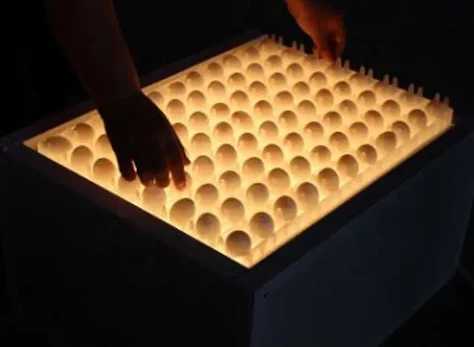
Commonly used egg illuminators
1.Egg illuminator 2.Flashlight egg illuminator 3.Sitting lamp illuminator 4.Portable egg illuminator
The first time is a headshot: 5~6 days after incubation, the main purpose is to observe the fertilization of eggs, and detect infertile eggs, dead embryo eggs, broken eggs, etc. Normally developed embryos, with thick blood vessels, many branches, bright red color, sinking egg yolk, and obvious embryonic eye spots; Weakly developed embryos (weak spermatozoa) have slender blood vessels, pale color, and a small diffusion surface of the vascular network, but the embryos can be clearly seen; Infertile eggs, commonly known as "white eggs", the whole egg is bright and transparent, and nothing can be seen, only the shadow of the yolk can be seen; Dead embryos, which show irregular blood circles or blood lines, and the embryos are small and sometimes have black spots.
The second time to shine the eggs: generally on the 11th ~ 12th day after incubation. The main thing is to remove the dead eggs. The well-developed embryo becomes larger, the egg is covered with blood vessels, the air chamber is large and well-defined, and there is a shadow of a motile embryo. The black shadow of the dead embryo egg is obvious, the surrounding blood vessels are blurred or no blood vessels, the egg is turbid, and the color is yellow.
The third irradiation of eggs: 18~19 days after incubation, mainly combined with the plate to check whether the embryo development is normal. In the embryo with normal development, the edge of the air cell at the blunt end of the egg is wavy, the blood vessels under the air cell are obvious, there is a black shadow at the sharp end, the embryo flashes, and it is hot to touch with the hand. The dead embryo is dark in color near the edge of the air chamber, the blood vessels are blurred, and it is cold to the touch.
In order not to affect the development of the embryo, the room temperature is raised to 28~30 °C, and the egg operation is fast, accurate, stable and safe.